Baloch Yakjehti Committee
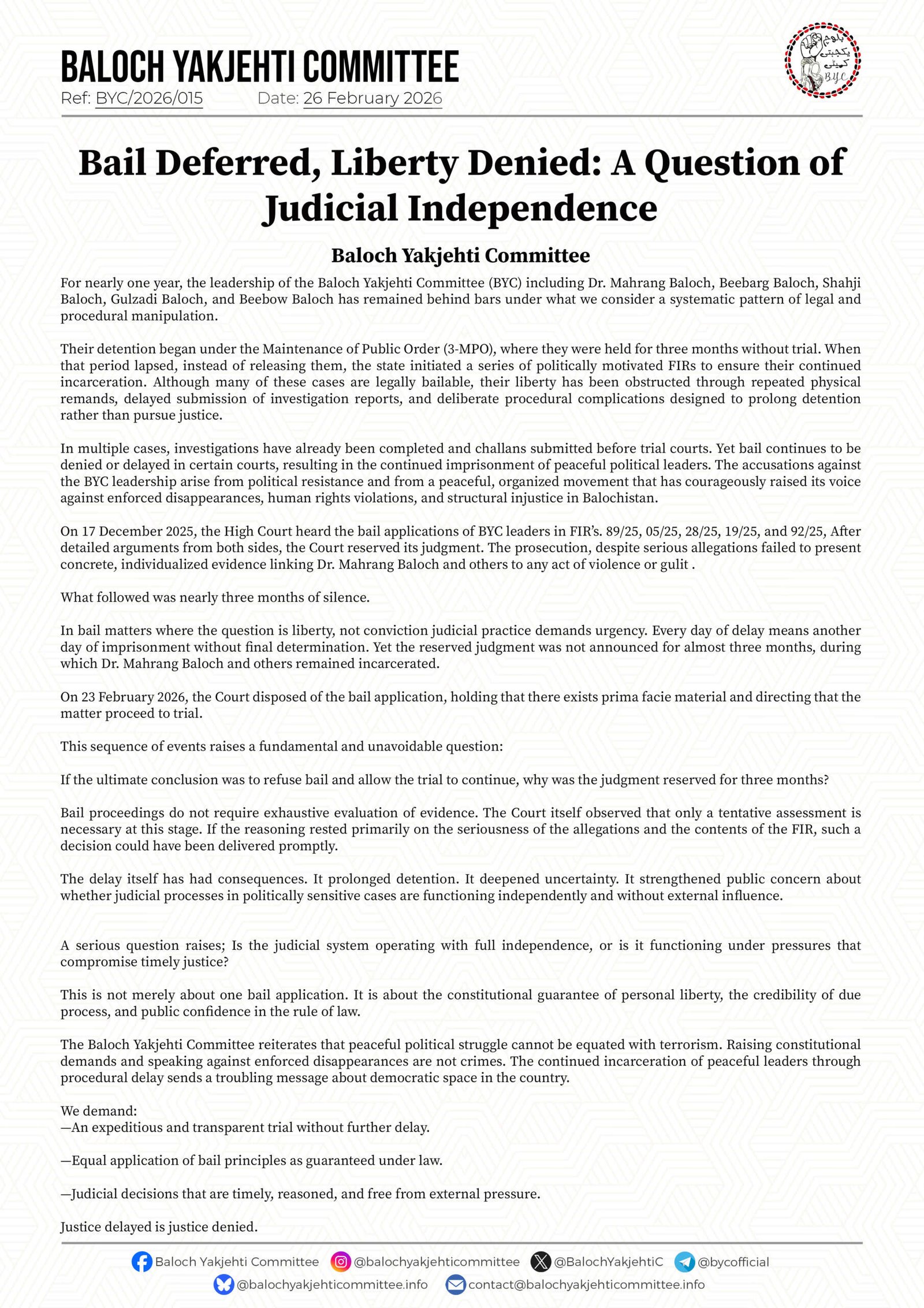
For nearly one year, the leadership of the Baloch Yakjehti Committee (BYC) including Dr. Mahrang Baloch, Beebarg Baloch, Shahji Baloch, Gulzadi Baloch, and Beebow Baloch has remained behind bars under what we consider a systematic pattern of legal and procedural manipulation.
Their detention began under the Maintenance of Public Order (3-MPO), where they were held for three months without trial. When that period lapsed, instead of releasing them, the state initiated a series of politically motivated FIRs to ensure their continued incarceration. Although many of these cases are legally bailable, their liberty has been obstructed through repeated physical remands, delayed submission of investigation reports, and deliberate procedural complications designed to prolong detention rather than pursue justice.
In multiple cases, investigations have already been completed and challans submitted before trial courts. Yet bail continues to be denied or delayed in certain courts, resulting in the continued imprisonment of peaceful political leaders. The accusations against the BYC leadership arise from political resistance and from a peaceful, organized movement that has courageously raised its voice against enforced disappearances, human rights violations, and structural injustice in Balochistan.
On 17 December 2025, the High Court heard the bail applications of BYC leaders in FIR’s. 89/25, 05/25, 28/25, 19/25, and 92/25, After detailed arguments from both sides, the Court reserved its judgment. The prosecution, despite serious allegations failed to present concrete, individualized evidence linking Dr. Mahrang Baloch and others to any act of violence or gulit .
What followed was nearly three months of silence.
In bail matters where the question is liberty, not conviction judicial practice demands urgency. Every day of delay means another day of imprisonment without final determination. Yet the reserved judgment was not announced for almost three months, during which Dr. Mahrang Baloch and others remained incarcerated.
On 23 February 2026, the Court disposed of the bail application, holding that there exists prima facie material and directing that the matter proceed to trial.
This sequence of events raises a fundamental and unavoidable question:
If the ultimate conclusion was to refuse bail and allow the trial to continue, why was the judgment reserved for three months?
Bail proceedings do not require exhaustive evaluation of evidence. The Court itself observed that only a tentative assessment is necessary at this stage. If the reasoning rested primarily on the seriousness of the allegations and the contents of the FIR, such a decision could have been delivered promptly.
The delay itself has had consequences. It prolonged detention. It deepened uncertainty. It strengthened public concern about whether judicial processes in politically sensitive cases are functioning independently and without external influence.
A serious question raises; Is the judicial system operating with full independence, or is it functioning under pressures that compromise timely justice?
This is not merely about one bail application. It is about the constitutional guarantee of personal liberty, the credibility of due process, and public confidence in the rule of law.
The Baloch Yakjehti Committee reiterates that peaceful political struggle cannot be equated with terrorism. Raising constitutional demands and speaking against enforced disappearances are not crimes. The continued incarceration of peaceful leaders through procedural delay sends a troubling message about democratic space in the country.
We demand:
—An expeditious and transparent trial without further delay.
—Equal application of bail principles as guaranteed under law.
—Judicial decisions that are timely, reasoned, and free from external pressure.
Justice delayed is justice denied.